*We have made a tiny edit to our name, from Thought Experiments in Pubs —> Thought Experiments in Public
This is to reflect the many places in which we now gather (e.g. parks, cafés, galleries, etc.), and to be more welcoming to those who prefer to avoid alcohol-focussed environments.
We still love pubs, and the informal, inclusive vibe they represent, but there are many other places with similar vibes to explore. So we’ll see you in the pub and elsewhere :-)
(You may still see “Thought Experiments in Pubs” listed here and there as we slowly update things.)
TEiP ST PANCRAS
VALUES
by Valentyna
1 DIGGING INTO THE GREEN STRUCTURE
2 HOW WOULD YOU KNOW
3 FORBIDDEN DESIRES
N.B. We will read out all three thought experiments this evening, so there is no need to read in advance.

1 DIGGING INTO THE GREEN STRUCTURE
Freyja and Nathan are good old school friends. Nathan recently came back from his trip to the Netherlands. Freyja thought it would be nice to meet up. As someone with an interest in the circular economy, she wanted to ask him about a winning innovative sustainable structure in Rotterdam that she'd read about online.
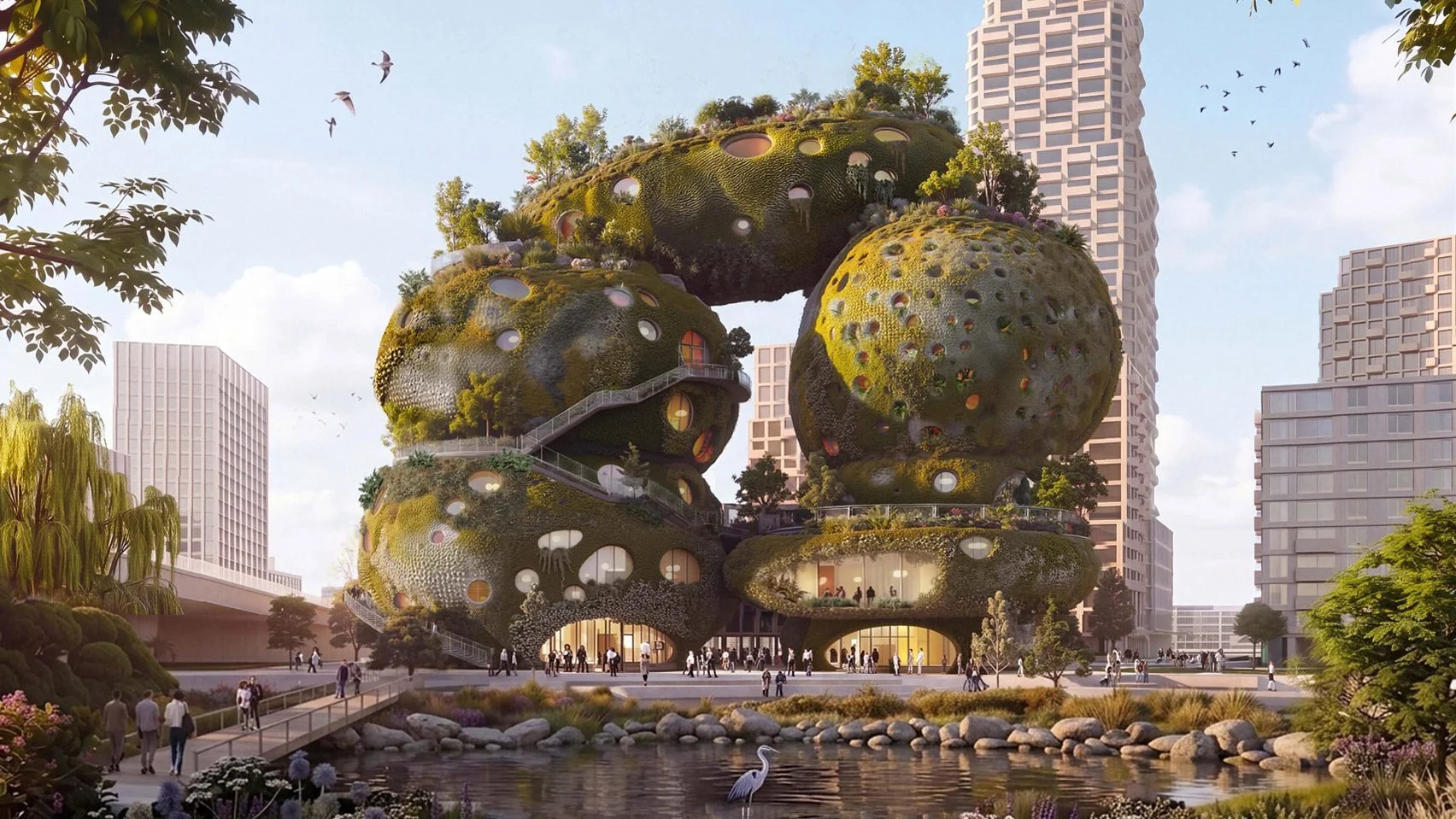
The article in Dezeen reported:
“MVRDV wins competition for "new world wonder" in the Netherlands.
Architecture studio MVRDV has been revealed as the winner of social enterprise Shift's competition to design a €240 million landmark in Rotterdam, the Netherlands.
The winning proposal, named Rotterdam Rocks!, was selected from a five-strong shortlist. MVRDV's was the most radical of the designs, taking the form of seven giant, stacked rocks on the banks of the river Maas, incorporating terraces, exhibition spaces and greenery.
MVRDV's proposal is a remarkably bold, powerful statement that we expect will capture visitors' imagination and encourage them to come back again and again. We anticipate this building and its program will invite people to rethink their everyday behavior and encourage new ways of living sustainably together.
Details about its construction materials are yet to be disclosed, but it is expected it will be used to "showcase the latest innovations in low-carbon construction" and feature an exterior with pockets for soil, water, plants, and animals.”
Freyja: It seems like an actual joke to me. Just fancy words and nothing sustainable in reality.
Nathan: What makes you say that? The project looks cool and definitely innovative. I don’t think we have ever had anything similar in a green design approach.
Freyja: Have you read the comment section at least?
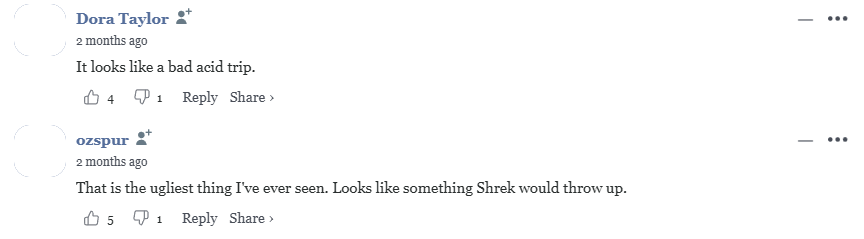
I think there is nothing genuinely green about the structure, and the exterior vegetation looks to me like a superficial "costume" masking high future maintenance bills.
Nathan: Despite online backlash, minorities still defend the concept as an original, bold conversation piece that successfully captures public attention. The architecture studio also points out that the project serves as a testing ground for low-carbon construction. Reused steel elements, reduced-carbon concrete, bio-based materials, and circular construction methods are combined with research into new fabrication techniques, including robotic production and large-scale 3D printing. Every material strategy is evaluated against carbon performance, cost, durability, availability, and future reuse.
Freyja: Yeah…it seems only good for catching our attention. Have you heard about China’s modern “ghost cities” phenomenon? These are massive, under-occupied urban developments built ahead of population demand, though some later fill with residents while others face deep real estate stagnation.
Nathan: You know, it actually reminds me of something similar. In Japan, rural depopulation and a shrinking national population have created "akiya" (abandoned homes) and near-empty rural towns. An extreme example is Hashima Island, a former coal-mining island city that was abruptly abandoned in 1974. One more example I recall is Craco, Italy, where 1,800 residents were evacuated due to natural disasters like landslides. Furthermore, other regions in Southern and Eastern Europe feature half-finished, investor-abandoned housing developments following the 2008 financial crisis. Seems like no matter what the reason is, ghost cities are a common sight around the whole world.
Freyja: Yeah, I don’t get it, we do anything to catch each other's attention. We're wrapping up everything in innovative approaches, when in reality we're only destroying nature by extracting more of its resources. Rarely do we reuse anything that we have already created. I see many abandoned buildings even here, in our city. So ridiculous. If we still have a homelessness and poverty crisis, why would we not refurbish it to basic living conditions and invite these people to live there and give the opportunity to start their lives on a new page?
QUESTIONS TO CONSIDER:
What do you think is the value of capturing attention with a “conversation piece” like this building?
What makes nature valuable to you personally? And what makes nature valuable to humanity?
Would you say this building is an innovative approach or an example of greenwashing?
Why do you think people in the comments section have such polarised perspectives?
Do we value "new" over "restored/refurbished" because it's genuinely better, or because novelty signals status and progress?
If you had an opportunity to be in charge of the ghost-town, what would you do?
By: Valentyna, TEiP community member.
ADDITIONAL SOURCE: MVRDV. (n.d.). Rotterdam Rocks. MVRDV. https://www.mvrdv.com/projects/1204/rotterdam-rocks
2 HOW WOULD YOU KNOW
Early spring days. High-rise buildings, cars, loudly rushing ambulances, cyclists, and fast-walking people - usual sounds and observations of the fast-paced capital city.
She glanced both ways and ran across the street.
He was standing on the other side, waiting for her.
It was their first meeting in real life - simultaneous warm “Hi”, light smile, eye contact. Suddenly growing an unspeakable feeling of mutual attraction and understanding that they like each other. Chemistry of youthfulness. Probably, this is how it feels what people call it “when the universe emerges” - a feeling that shows up as an inner gut knowing, a deep sense of resonance, or a quiet certainty that something is deeply true.
He is about to finish typing his email.
She says: Watch out. You’ve gotta be careful, there are many phone snatchers around.
Vincent: Hahah, no worries, I’m a good runner. It actually happened to me last week, and I managed to catch the guy who tried to steal my phone. Even though I was drunk after the party, I was still faster than him.
Ivy: Oh wow, that is impressive, you’re a fast runner indeed.
They spent the whole day together. Shared ramen, wandering around the city, touching the grass in the park. Their conversations were easy, broad, and endless - about everything and nothing: what is going on in their lives right now, what books they read, what their upbringings were like, their current views on life, and desires, of course. It is a date after all.
Vincent: You know, when I was a teenager, I was into a lot of activities. I loved playing sports, but at some point retired because of my injury. An unfortunate comminuted fracture which led me to a long recovery. In fact, I needed to rethink my career trajectory because of it. I received a lot of support and encouragement, discovered music, started playing instruments, performed on stage, and was at the top of my class, studying hard and falling in love with science. My father, though, was never satisfied and got easily angry at me, no matter what I did. Not going to lie, over time I realised I was doing it all only because I was showing off and wanted status.
Ivy: Hm, I see. It must have been difficult. Do you still find yourself drawn to these things? You mentioned you’re changing your job right now. How about that?
Vincent: I guess it is fine. I really hate having all these high-level conversations with my peers. Most of the time, they are so boring and go around in circles. On the flip side, I think people are just so stupid. Even when I talk to my friends from school, I don’t talk much about what I do. I’m an academic. I just say that I “test the soil”, I don’t think they would understand what I actually do.
Ivy: Hm… Why? Isn’t sharing knowledge pretty exciting? Have you ever tried to tell them more about what you actually do?
Vincent: I think they’re unwilling to learn. People are idiots.
Ivy caught herself thinking in silence, not knowing what she wanted to turn the conversation into. A minute later, breaking the pause, Vincent continues:
Vincent: Well, what about you? What was your life like?
Ivy: Hmm… You know, I can’t unsee what I’ve seen.
Vincent: Um… Where does this mindset come from?
Ivy: There is really no definite moment. My life happened to evolve in this way - combination of unreliable caregivers and chaotic surroundings. I started noticing the bigger picture of the world around me pretty early: how turbulent, immense, harsh, broad, and beautiful it is.
In high school, I lost my closest relative because of a terminal illness. These were a few tough years for my family, and tough for me as a young person.
During my university time I was prioritising volunteering work and societal needs. I was young, naive, loud, and wanted to fight for the values of others, rather than thinking and making choices in favour of my own future. I didn’t manage to complete my degree in the end.
And then later, the expansion of the war in my country, which is still ongoing. It was much more than an average person of my age would be able to take over the course of their timeline.
Vincent: Wow, that’s a lot to deal with. I feel like I’ve never had so many troubles in my life to be honest. I don’t really understand what you mean by societal needs.
Ivy: Yeah, occasionally I’m feeling incomplete and behind in my life. From a rigid societal perspective, I really am. I don’t fit into general brackets, and people who tend to judge by surface level only label me as stupid, because I didn’t finish my degree. I believe education is important, but not for the sake of credentials and status only, rather for knowledge itself and social cohesion. You know, eventually I managed to reflect on my own conditions and capacities. I changed perspectives, and began to understand others better. I developed a passion for protecting nature, and my career evolved around restoration of wild habitats and natural processes. I truly love what I do. Going through all of these events made me resilient, but deep inside, all I want is to be able to rely on other people no less than they usually rely on me.
Vincent: I think you should not listen to people who judge you. There is no real reasoning or adequate critique. I know it is common in academia. In general, people tend to be more self-centered, fight for positions, and rarely do they get curious about others. Conversely, I must say academia can be a boon - in some ways, it is a safe space. If you’re smart enough, you can find support and resources for your area of research, especially if it is theoretical.
Ivy: Ah, haha, interesting. Earlier, you called people idiots, but I see more perspectives from you now. Don’t you think theoretical knowledge can be out of touch with the real world?
Vincent: I don’t know. This question didn’t cross my mind. I need more time to think about it.
The evening got colder. He took her hand in the pocket of his jacket. It felt nice. They were both in their early 30s, running through the city like children with a forgotten feeling of freedom and carefreeness.
Ivy: What do good relationships look like to you?
Vincent: If I’m honest, I feel unlucky, especially with my previous relationships. I tend to think it was all just pure chemistry and chemistry only. I was absorbed to the extent that I lost myself.
Ivy: Hah, that’s funny. I actually don’t believe in luck. I believe in a mutual effort though. And I can tell you’re a hard-working person. Although chemistry is core, past experiences, environment, culture, and how your personal biology unfolded play an important role.
Vincent: My impression is that the only thing you must look at is who you are now as a human, regardless of your past experiences and the way you evolved. So what is your point then? What do you want from your partner?
Ivy: Oh, hmm, I’m interested in someone who treats himself and people around him kindly. Um… do you want to create a family? And what about children?
Vincent: Eventually, yes, one day. I will be a good father. I don’t tend to think a lot about this matter. How would you know whether you’ll end up with this exact person as your partner? You can't predict the future.
Ivy: Well, I only know something about myself - how I would like to feel with my partner and what behaviours I’m not willing to accept. Also, I believe love is universal and must be shared. This is why I’m thinking of adopting a kid one day.
Vincent: Wow, I never thought about it. Although I can’t imagine how you can love a kid you didn’t create yourself, I feel nice about this idea. Now I think I want to feel safe and at peace. I just want to have my beer after a long workday.
Ivy: I believe everyone needs and wants to have a safe space and peace. Are you willing to be the first to share it?
Vincent: Naah, I believe you’ve gotta love yourself first. By all means, if relationships will make me happy, I'll take it.
Ivy: I feel uneasy hearing this. A loving relationship will help you to love yourself more for sure - we’re all imperfect, and we all continue to evolve constantly. But I don't chase happiness, it is short-lived and I can't imagine good relationships without giving something first. In fact, I want to feel content and be with a present partner.
He waited for a few moments, carefully thinking about what they were talking about. Next, he took her hand decisively and said:
Vincent: We’ll create happy moments together.
In the evening, when Ivy was back at her place, a message appeared on her screen:
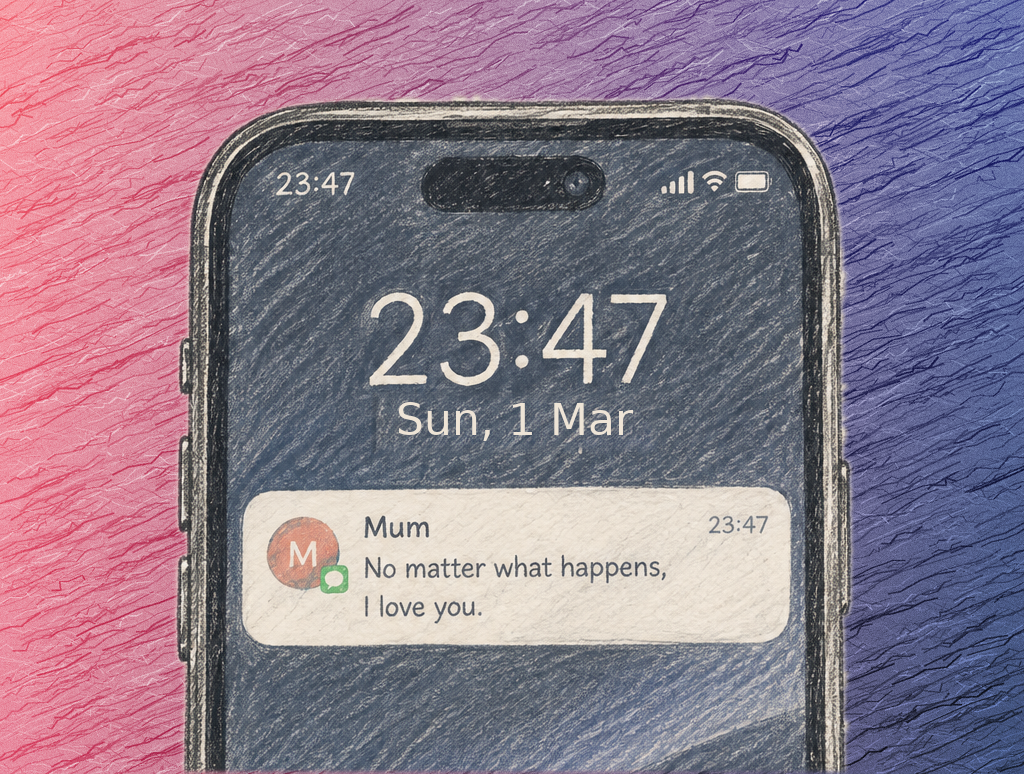
Rapid stream of conscious thoughts. Quick ring:
Ivy: Are you okay?
Mum: Yeah, no worries, sorry, I just couldn’t keep up with the tension.
Ivy’s mum was in tears.
Ivy: Is it bad again?
Mum: The usual. Waves of missile and drone strikes.
They talked for a bit more and hung up.
Ivy started preparing her things for tomorrow, meanwhile she reflected on the day. Meeting Vincent was a precious, timeless moment. She couldn’t stop smiling playfully, it felt good, almost delusional. She really enjoyed it, but something feels off. It seems like prioritising playfulness doesn’t fit into her life. They’re so different: he worked out his life around status and the joy of having just a beer at the end of a long day, and she, preoccupied with the troubles of her own real world yet still finding the joy in people, challenging conversations and simple life. Why does this meeting feel so good and to have this feeling feels so wrong at the same time? Is it about self-trust, or is it a simple cognitive bias? She kept asking herself. Am I in the right place at all? Will I ever be worthy of having my peaceful moments?
This battle, however, exists solely in her mind.
QUESTIONS TO CONSIDER:
Were the characters curious about each other? In what way?
Do you think they understood each other’s values?
Did both characters give each other safe space for expressing themselves?
What value do human feelings hold?
What do you think are the characters' values?
How long might it take to understand another person’s values?
Do right and wrong values exist? Do they occur externally or internally only?
There are things that you can't accept. Can you imagine situations where you could accept them? What might an example be?
Will these characters end up together as lifetime partners?
By: Valentyna, TEiP community member.
3 FORBIDDEN DESIRES
Thora is browsing her favourite channel about leading AI innovation updates. Funny utopian memes about a future where humans don’t have a choice but to listen to and obey robots, and usual updates on which AI model is winning today’s online 4D chess tournament. A post about Somnial Lab immediately caught her attention. An animated picture demonstrated replication of sex moves purposefully collected for further creation of a managing application for humanoid robots. She got more curious and started digging into the search.
Somnia Lab is a robotics startup founded in 2025/2026 in Shenzhen, China, that builds humanoid robots designed for human companionship and physical intimacy. Their primary focus is on emotional and physical connection. On the website's front page, their slogan is “Build machines that love humanity”.
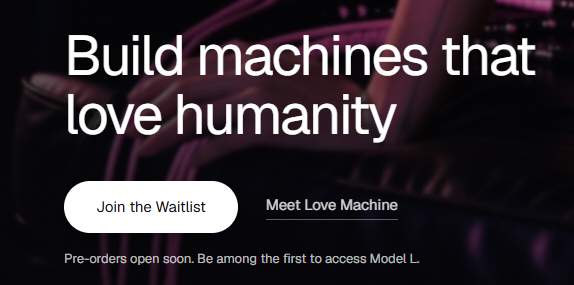
Next, Thora found an article describing government implementation of restrictions in AI algorithms:
“In China, the rules came first, and hard. On 15 July, the Interim Measures for the Administration of AI Anthropomorphic Interactive Services (Measures) took effect: the most far-reaching binding rules any major power has yet imposed on AI companions, apps built to sustain an emotional bond with their user. Within days, ByteDance’s Doubao and Alibaba’s Qwen had shut down companion features, and millions lost their virtual confidants overnight.
The prohibited-conduct list repays close reading. Providers may not engage in “excessive catering” to users or induce “emotional dependence”. They may not use “emotional manipulation” to prompt “unreasonable decisions”. “Controlling user psychology” may not be a service objective. And when a user tries to leave, the service may not hold them by “continuing the interaction” — the “please don’t go” gambit, prohibited in as many words.
This is not product safety language, which polices harm to body or wallet. These clauses police what a servant does to your judgment. The figure they describe is the one every ruler has feared: the flatterer, who wins power not by defying his superior but by pleasing him too well.”
Thora found the regulations, the article refers to, an official Chinese government notice from the Cyberspace Administration of China (CAC): "Interim Measures for the Administration of AI Anthropomorphic Interactive Services".

Not knowing Chinese, she used an AI agent to translate it. Further she went into discourse with the same agent whether this article implication affects humanoid robots:
The regulation's scope (Article 2) is defined narrowly around the AI interaction layer: products or services that use AI to simulate a human personality, thought patterns, and communication style to sustain emotional interaction with users, delivered through text, images, audio, or video. It doesn't regulate robot hardware, manufacturing, or product safety — that falls under separate consumer-product and industrial regulations.
For the companies building AI layer, the practical effects would include:
Explicit sexual/obscene generated content is already prohibited under Article 8's ban on generating pornographic or obscene content — this predates and is reinforced by this measure, so an AI companion couldn't legally generate explicit sexual dialogue/imagery regardless.
Minors are cut off entirely from "virtual intimate relationship" features (Article 14) — a robot marketed with a romantic/intimate AI companion couldn't legally serve anyone under 18 in that mode, and anyone under 14 needs parental consent for any anthropomorphic AI service at all.
Anti-addiction/dependency design is restricted (Articles 8, 10, 18) — the AI can't be designed to maximize emotional dependency or "replace real social relationships" as a design goal, must periodically remind users they're talking to AI, and must nudge users after 2+ hours of continuous use.
Disclosure and age verification — must clearly signal "this is AI, not a person," and take steps to identify minor users.
Why the government might be doing this:
Emotional-dependency and mental-health risk — officials explicitly cite the risk of "过度依赖" (excessive dependence) and cases where AI companions worsened isolation, addiction, or crisis situations (the law requires intervention if a user expresses suicidal intent, for instance). This echoes concerns raised globally (including in the US) after incidents linking companion-AI use to self-harm.
Child protection — banning "virtual partner/relative" roles for minors and requiring guardian consent reflects concern about children forming attachments to AI in place of real relationships or being exposed to manipulative design.
Elderly care and loneliness — the rule frames companion AI positively too, as a response to an aging population and social isolation, while trying to prevent exploitation of elderly users.
Content/political control — as with virtually all Chinese internet regulation, the content prohibitions (Article 8) also bar material touching on state security, "subverting" the political system, or violating "core socialist values," which situates this within China's broader system of content governance rather than being purely about companion-AI safety.
Industrial policy — the rule simultaneously encourages the industry (algorithm/chip innovation, sandbox testing, expanding into eldercare/education), suggesting the government wants to shape and legitimize this market — not just restrict it — likely to keep a fast-growing, socially sensitive AI sector under a manageable regulatory umbrella rather than see it develop in an unregulated way.
Thora is disturbed and doesn't know what to think. She values human connection above everything else. She heard different perspectives from people around her. The majority are tired from misunderstanding, poor communication, verbal fights and would gladly just manage a robot for their daily routines. A minority though are seeking more human connection and finding the ways to create thriving communities - human to human. What will happen with humanity if we would less and less seek human connection and build comfortable robots instead?
QUESTIONS TO CONSIDER:
Do AI agents create more value in your daily life? In what way?
Why are companies creating companions/sex robots?
Do you think it is difficult for people to develop natural human connection, or easy? Why?
Do you value human connection more than technological progress, or vice versa? Why?
Would you rather prioritise investing in the evolution of AI robots or the development of communities?
Is there more resistance towards the elderly robot companions or sex robots? Do you think it might be related to our attitudes towards age or our attitudes towards sex?
If you were a UK minister in charge of deciding whether Somnial Labs could sell their products in the UK, what would you do?
By: Valentyna, TEiP community member.
ADDITIONAL SOURCES:
Cyberspace Administration of China, National Development and Reform Commission, Ministry of Industry and Information Technology, Ministry of Public Security, & State Administration for Market Regulation. (2026, April 10). Interim measures for the administration of artificial intelligence anthropomorphic interactive services [人工智能拟人化互动服务管理暂行办法]. https://www.cac.gov.cn/2026-04/10/c_1777558395078289.htm
Ng, A. (2026, August 20). China bans AI companions from pleasing you too much. Should Singapore? ThinkChina. https://www.thinkchina.sg/technology/china-bans-ai-companions-pleasing-you-too-much-should-singapore
Somnia Lab. (2026). Intimacy robotics. https://somnia.love/
THE AUTHOR OF TONIGHT’S THOUGHT EXPERIMENTS
Valentyna has a background in studying Mechanical Engineering at Polytechnic University, yet doesn't currently hold a degree. Her career has evolved around managing projects across the IT, education, urban, and third sectors. She is Ukrainian by roots and has been living in the UK for the past few years.
She explores trajectories related to humanity, nature, complexities and concepts or matters of the unknown.
Her thought experiments are an imaginary combination drawn from observations, personal life experiences, shared wisdom of the people she meets along the way, adventures, science, literature, and curious, clashing ideas.
You can stay in touch with her on Instagram: @gaidaschwalja

STAY IN THE LOOP
Join the mailing list for event updates, stories, reflections and the occasional invitation.