TEiP HERTFORDSHIRE
TRUTH AND LIES
By Sharda Dean

1 SPOT THE LIAR!
You suspect that a close friend is lying to you about something important. You begin to wonder whether there is any reliable way of telling. A friend says it’s all about eye contact, another says, ‘you’ll just feel that something is off’, but both approaches seem a little unscientific. When searching the internet for useful information, you stumble across the following article.
Vrij, Granhag & Porter (2010), Pitfalls and Opportunities in Nonverbal and Verbal Lie Detection, Psychological Science in the Public Interest, 11(3), 89–121. (Sage Journals)
The authors point out that people, including professionals such as the police, often place too much weight on outward signs of nervousness as an indicator that someone is lying.
The authors explain that this is not a reliable indicator of deception. They argue that liars may actively try to appear credible by, for example, holding eye contact and appearing relaxed, which can make it difficult to tell the difference between a good liar and someone who is telling the truth.
At the end of the paper, the authors discuss some strategies to improve one’s lie-detection skills.
One way is to ask liars detailed questions that they have not anticipated and therefore have not had a chance to rehearse an answer to.
Another technique is to exploit the fact that lying is more difficult than telling the truth and therefore imposes a greater cognitive load. You can make use of this fact, for example, by asking someone to tell you what happened but in reverse. So, a policeman might ask a suspected criminal to explain their whereabouts on a particular day from the end of the day to the beginning rather than chronologically. Under these circumstances someone lying might be more likely to trip up and make a revealing error.
QUESTIONS TO CONSIDER
Have you ever tried to work out whether someone was lying to you? What ways did you use? Or would you prefer to respect that if someone is lying to you, they have their reasons.
Do you think people should be honest whatever the consequences?
Is there anything that you’d rather not know the truth about, about yourself?
Is withholding the truth, a lie?
Is it fair to deliberately make an interview difficult in order to expose a liar? Under what circumstances… in court, at work, at home?
Why might lying require more mental effort than telling the truth? Is that always true?
If you had magic lie-detecting powers, would your life be happier?
Thought Experiment by: Sharda Dean
2 RUBY & JACK
Ruby is your best friend. You find out that her husband, Jack, is having an affair.
You know that Ruby does not know about his infidelity.
QUESTIONS TO CONSIDER:
What would you do and why? Note: doing nothing is also an option.
Would your response to question 1 change if Ruby and Jack had young children? Why or why not?
Would your response to question 1 change if you were best friends with Jack and it was Ruby having the affair?
Are there any other circumstances not mentioned that might change your initial course of action?
If you were Ruby, would you prefer to know the truth? Why or why not?
Years later, Jack is about to remarry. Should he tell his new partner about his past affair?
At a friend’s party you meet Jack’s fiancée and in a long conversation she explains to you how important fidelity is in a life partner and how pleased she is that she’s finally found someone who can be faithful. Would you tell her what you know about Jack?
Thought Experiment by: Sharda Dean
3 IMAGINE A POLITICIAN
Imagine a politician who comes to power promising to change the country.
He is rich, confident and outspoken. He promises to restore national pride, challenge the political establishment and stand up for ordinary people. Many voters feel that, at last, someone is speaking up for them and will look after their interests.
But the politician regularly makes statements that are false. He exaggerates his achievements, invents statistics, misrepresents his opponents and make claims that independent journalists and experts repeatedly show to be untrue. The politician dismisses the fact-checks as biased attacks from a hostile media.
The politician's supporters continue to back him. They admire the politician for being outspoken and willing to challenge the status quo. The more the politician repeats these false claims, the more his supporters believe they are true. The lies seem to strengthen his relationship with his supporters because he is telling them what they want to hear.
It becomes difficult for the media, or even members of the politician’s party to criticise him or hold him to account. However, he also seems intent on going down in history as the ‘best leader’ the country has ever had.
QUESTIONS TO CONSIDER:
Should we expect politicians to tell the truth? Why?
Why might it suit some politicians to lie?
If the lies that the politician in the story tells are comforting to his supporters and give them hope and a sense of being listened to, does it matter if they are lies? Why or why not?
If a politician lies to achieve something you believe is genuinely good for the country, would you vote for them?
If a politician is powerful enough to decide which news sources people trust, which experts they listen to and which facts they accept, how does the ‘truth’ get out?
Why is being able to hold politicians to account an important part of a well-functioning democracy?
‘History is written by the victors’ is a phrase, sometimes attributed to Winston Churchill, that implies that history is highly subjective, and might be biased in favour of the powerful, do you agree?
Thought Experiment by: Sharda Dean
Additional sources: Raunak M Pillai, Eunji Kim, Lisa K Fazio, All the President’s Lies: Repeated False Claims and Public Opinion, Public Opinion Quarterly, Volume 87, Issue 3, Fall 2023, Pages 764–802, https://doi.org/10.1093/poq/nfad032
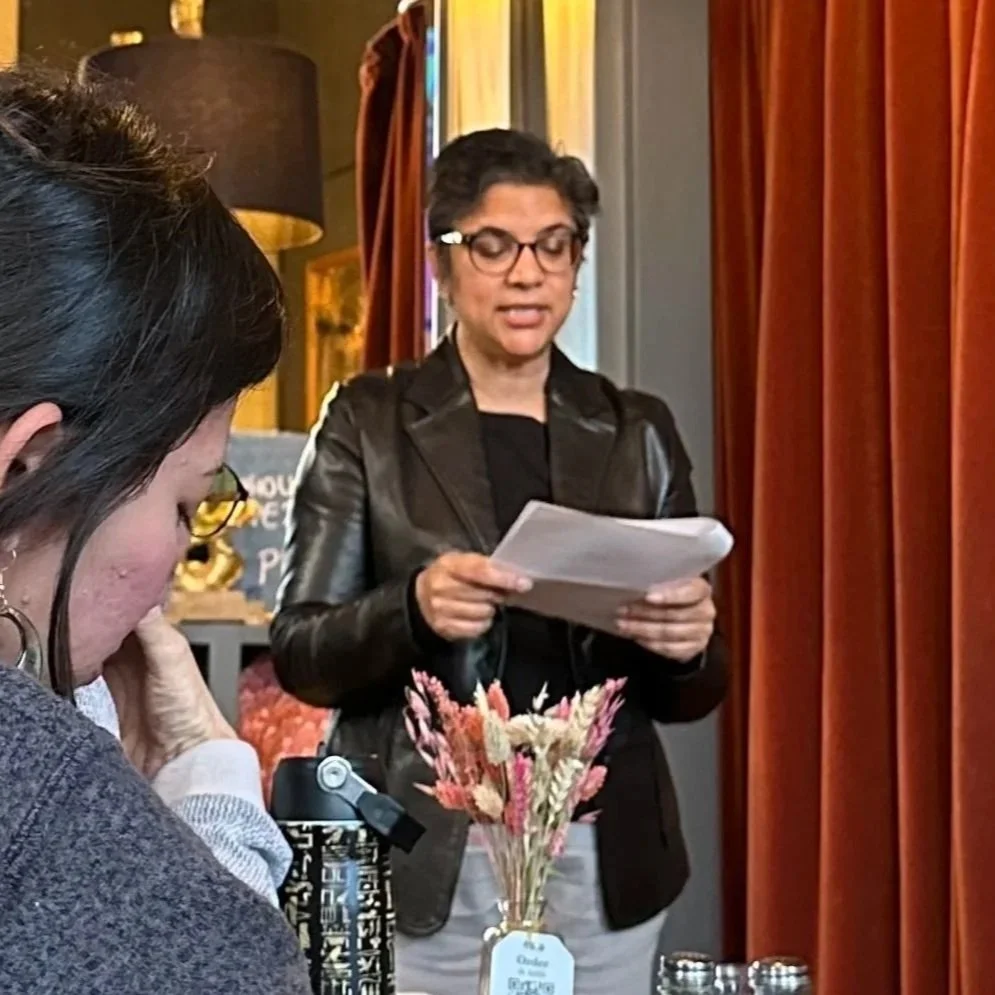
THE AUTHOR OF TONIGHT’S THOUGHT EXPERIMENTS
Sharda Dean is an economist, wedding celebrant and community builder who lives in Potters Bar in Hertfordshire.
She runs ‘Thought Experiments in Pubs (TEiP) - Hertfordshire’, part of the THOUGHT EXPERIMENTS IN PUBLIC (TEiP) network founded by Bonny Astor.
Sharda has been an active and valued member of the TEiP London community since 2025 and has contributed original thought experiments to London events.
In writing thought experiments, Sharda draws inspiration from all the love, loss, joy, heartbreak and the occasional bout of rage she has experienced in her 50+ years. She also reads widely, listens to a lot of Radio 4, has three sons and three degrees in economics.
KEEP IN TOUCH
Join the list for updates about the wider TEiP network. (Minimal comms, unsubscribe anytime).