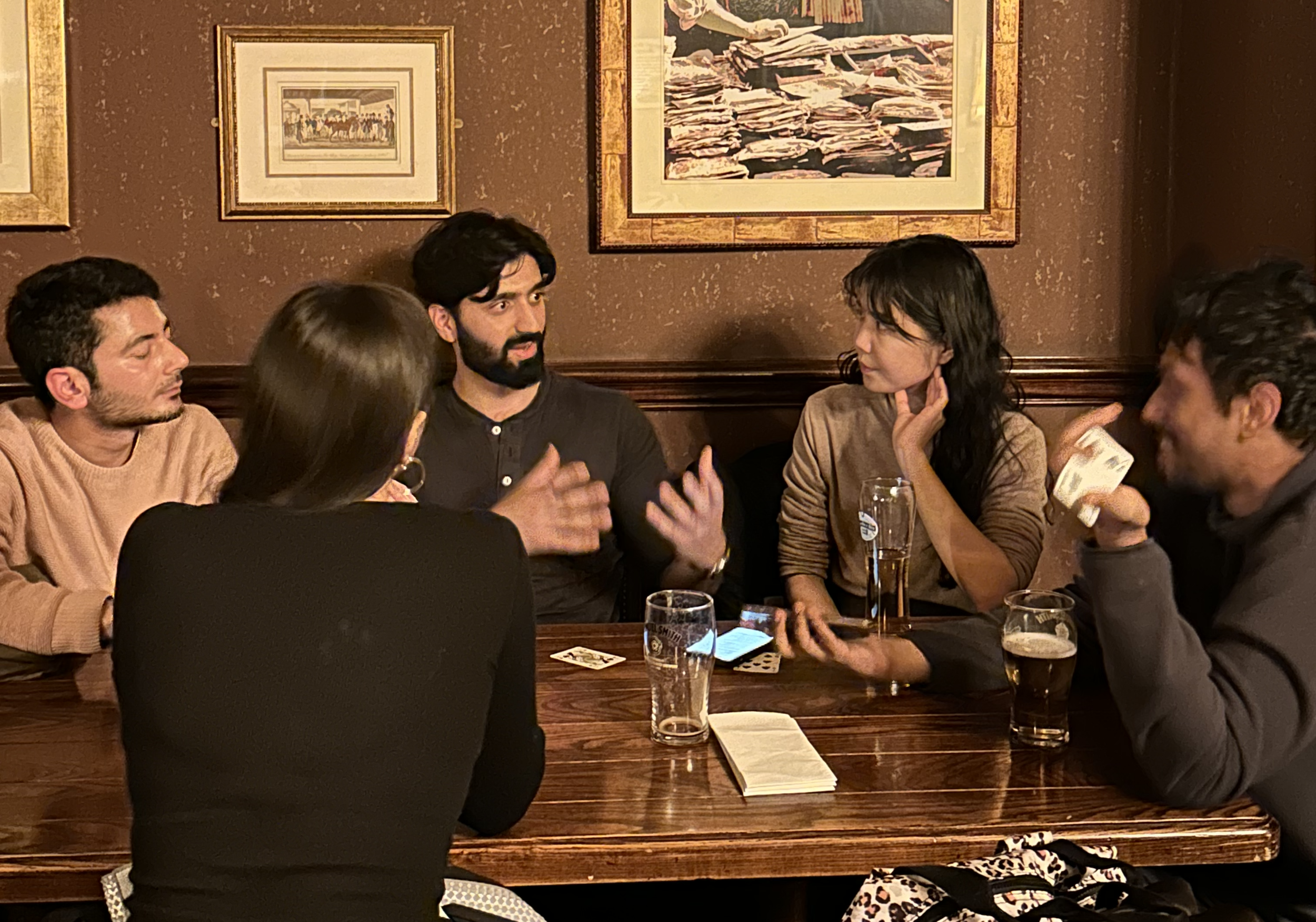
N.B. We have made a tiny edit to our name, from Thought Experiments in Pubs —> Thought Experiments in Public
This is to reflect the many places in which we now gather (e.g. parks, cafés, galleries, etc.), and to be more welcoming to those who prefer to avoid alcohol-focussed environments.
We still love pubs, and the informal, inclusive vibe they represent, but there are many other places with similar vibes to explore. So we’ll see you in the pub and elsewhere :-)
(You may still see “Thought Experiments in Pubs” listed here and there as we slowly update things.)
TEiP HERTFORDSHIRE
LAUGHTER
By Sharda Dean

1 WHY DO WE LAUGH?
A psychologist, Robert Provine, researching laughter, invited subjects to individually watch recordings of comedy shows. He was surprised to find that people, who otherwise laughed quite easily, elicited only a few begrudging chuckles during the experiment. In his 2001 book he said “my failure to elicit laughter… was actually a success in disguise… by not laughing my subjects were announcing that laughter is a social behaviour that virtually disappears in isolated people being scrutinized in a laboratory setting.”
QUESTIONS TO CONSIDER
Why might some things seem funnier when we're with other people than when we're alone?
Why do we laugh more with some people and not others? In your experience what’s the difference between those you often laugh with and those you don’t? Is it to do with their personalities, your relationship with them or something else?
Is a good sense of humour something you look for in a partner, why?
Does what we laugh at reveal something about us? Discuss.
What role do you think ‘gallows humour’ (ie dark or ironic humor in a desperate or hopeless situation) plays within groups under pressure or facing hardship together?
Have you ever been in a difficult situation where dark humour played a role in bonding a group of people to get through a difficult situation? If you would like to, please share your experiences.
Psychologists studying laughter suggest that it evolved partly to strengthen social bonds particularly once early humans began to form larger social groups. Is laughing together bonding? Why?
Have you ever been in a situation where everyone was laughing at something and you didn’t find it funny? How did you feel? What was the difference between you and them?
What role does humour or laughter play in your life? Does it affect who you choose as your friends, what you watch on TV or the events you attend?
By: Sharda Dean
ADDITIONAL SOURCES:
Robert R. Provine (2001). ‘Laughter – A Scientific Investigation’, published by Penguin Group, 2001.
R. I. M. Dunbar (2022). Laughter and its role in the evolution of human social bonding. Phil. Trans. R. Soc. B 7 November 2022; 377 (1863): 20210176. https://doi.org/10.1098/rstb.2021.0176
2 MEN, WOMEN AND HUMOUR
Caldwell and Wojtach (2020) wanted to investigate a surprisingly persistent stereotype, that men are funnier than women. So, they ran an experiment. Men and women wrote captions for cartoons, and then hundreds of independent judges rated the captions without knowing who had written them or their gender.
The results were very interesting.
When male and female contestants did not have much confidence in their ability to make people laugh, men's captions were rated as funnier. But when the male and female contestants were primed by those running the experiment to have more confidence in their ability to make people laugh, women's captions were rated as funnier than men’s. In other words, confidence in your ability to be funny may be a more important determinant of how funny you are than gender.
So, according to this study, the secret to being funny isn't being male or female. It's being confident.
QUESTIONS TO CONSIDER
In your experience are men are funnier than women or the other way round?
If you had a daughter, and you had to choose between her being funny or beautiful, which would you choose and why? Would your answer change if your child were a boy?
What do you find more attractive, people who make you laugh or people who laugh at your jokes? Would your answer change if you were a different gender?
Is being funny a talent you are born with or something you can learn?
Are there some times when you are funnier than others? What makes the difference?
If you consider yourself funny, how did your ability to make people laugh start and where did it come from?
Are funny people more successful?
Assuming that women are as funny as men, why might women find it harder to break through into being successful stand-up comics?
In a 2008 research paper by Daniel Howrigan and Kevin MacDonald, they found evidence that being funny was a good indicator of intelligence. Do you agree? What does someone’s ability to be funny tell us (if anything) about their past, their character or their abilities?
By: Sharda Dean
ADDITIONAL SOURCES:
Caldwell, T.L., Wojtach, P. Men Are Funnier than Women under a Condition of Low Self-Efficacy but Women Are Funnier than Men under a Condition of High Self-Efficacy. Sex Roles 83, 338–352 (2020). https://doi.org/10.1007/s11199-019-01109-w Published: 09 December 2019
Howrigan, D. P., & MacDonald, K. B. (2008). Humor as a Mental Fitness Indicator. Evolutionary Psychology, 6(4). https://doi.org/10.1177/147470490800600411.
3 PUNCHING UP OR PUNCHING DOWN?
Adapted from ‘The Ethics of Offensive Comedy: Punching Down and the Duties of Comedians’ by Emily McTernan.
Comedy is often subversive. When you attend a comedy performance you may be exposed to jokes that make you feel uncomfortable and that push the boundaries of what you think it is okay to joke about. Indeed, some comedians seem to revel in making their audiences feel shocked or uncomfortable.
Are comedians free to tell any joke they like, or are some jokes morally unacceptable?
Sometimes, comedy targets the vulnerable, marginalised, and oppressed. In particular, it can repeat negative stereotypes about particular groups, insult them, or make light of the injustices they face (e.g. racist or sexist jokes).
Which jokes ought not to be told? We might adopt the distinction that some comedy venues implement - ‘don't punch down’! That is, don't make offensive jokes that target those with less power, those who are vulnerable, marginalised, or oppressed. By contrast, ‘punching up’ - jokes that take aim at the powerful, are permissible, even admirable.
Adapted from ‘How Britain fought Hitler with humour’ – BBC.co.uk
The Nazis could not stop foreign radio waves crossing into Germany during WW2, but they could make listening to enemy stations a crime. Those caught were jailed and spreading news from enemy broadcasts was punishable by death.
Despite this, the BBC’s German Service used satire (broadcast in German) to connect to ordinary Germans during World War Two. The makers of these satirical programmes were unsure they were having any impact but after the war a flood of thank-you letters arrived from listeners to the German Service. Here are some extracts from the letters:
“The London [BBC] broadcasts saved me from suicide during the blackest days of the Hitler war”
“It’s thanks to the BBC and the BBC alone that I had the moral strength not to become complicit.”
“That you also brought us humour made the unbearable bearable for us”
QUESTIONS TO CONSIDER
Are there any subjects that should be completely off-limits for comedians?
Do you think "don’t punch down, punch up" is a useful rule for comedy? Are there any exceptions?
Some psychologists believe that laughter may have evolved to help groups to socially bond, how might laughing at another group of people assist in this? How might it be divisive?
Why do humour and offence often go hand in hand? Is it possible for a joke to be morally unacceptable and genuinely funny at the same time? Is it possible to be genuinely funny and not to offend anyone?
Do you think people today are more easily offended than in the past? Why or why not?
If an offensive joke is told in a room where no one is offended, does it matter?
Suppose a comedian made fun of a group that you belong to. What would determine whether you found it amusing, offensive, or both? If the comedian is of the same group they are making fun of, does that change how you would feel about the joke? Why?
Have you had the experience of being laughed at? How did you feel? Has that experience affected how you view comedy that targets the vulnerable?
Does comedy have a duty to challenge or ‘speak truth to power’ or is it ok to simply make people laugh?
Why might some ordinary Germans have had such a positive response to the satirical programmes broadcast by the BBC in German during WW2?
Why did the BBC choose comedy as a way of undermining Hitler’s regime?
By: Sharda Dean
ADDITIONAL SOURCES
Emily McTernan, The Ethics of Offensive Comedy: Punching Down and the Duties of Comedians, published online by Cambridge University Press: 28 April 2025
How Britain fought Hitler with Humour, Kirstina Moorehead, 30th August 2019. BBC.co.uk. https://www.bbc.co.uk/culture/article/20190829-how-britain-fought-hitler-with-humour
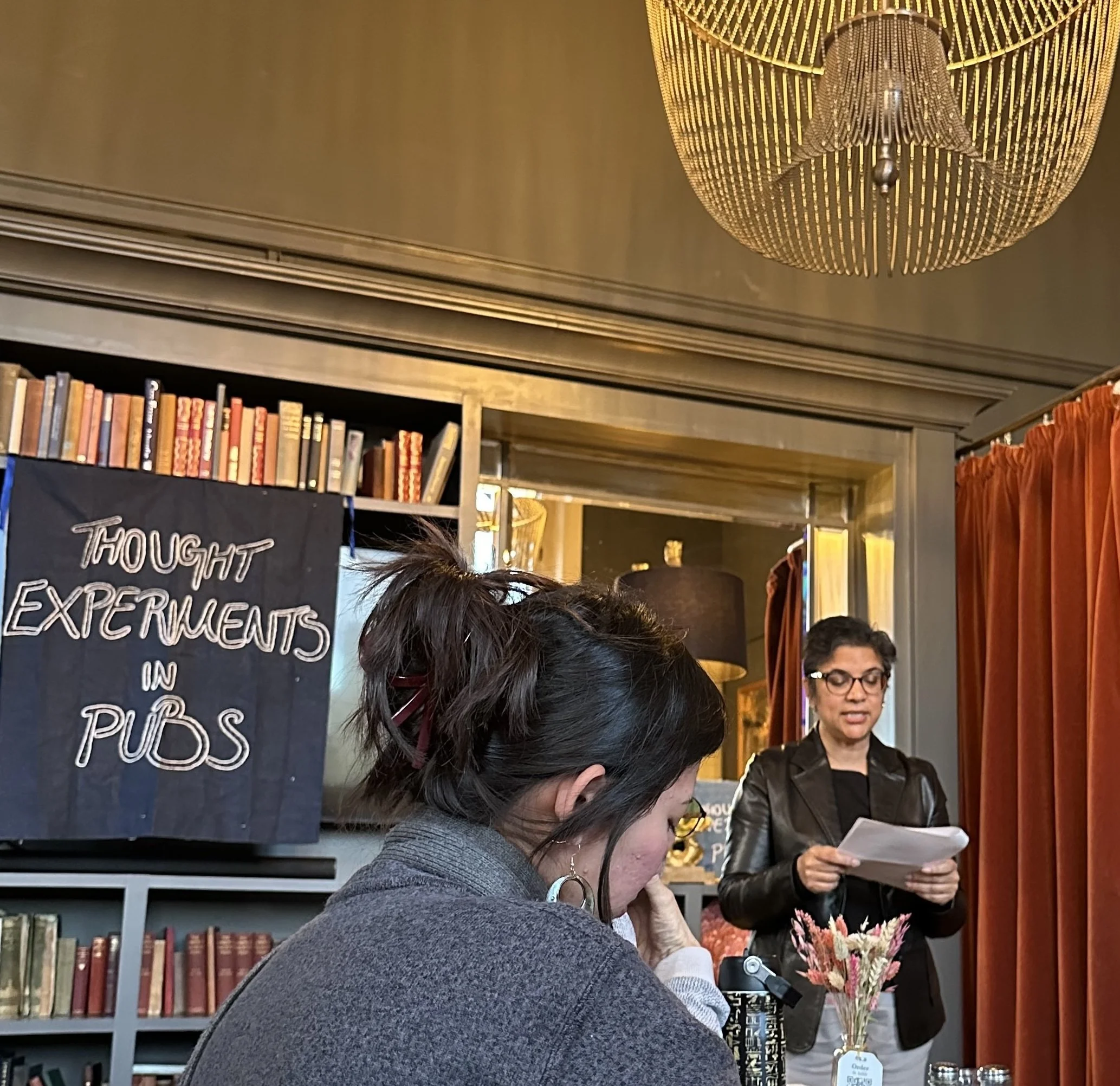
THE AUTHOR OF TONIGHT’S THOUGHT EXPERIMENTS
Sharda Dean is an economist, wedding celebrant and community builder who lives in Potters Bar in Hertfordshire.
She runs ‘Thought Experiments in Pubs (TEiP) - Hertfordshire’, part of the THOUGHT EXPERIMENTS IN PUBLIC (TEiP) network founded by Bonny Astor.
Sharda has been an active and valued member of the TEiP London community since 2025 and has contributed original thought experiments to London events.
In writing thought experiments, Sharda draws inspiration from all the love, loss, joy, heartbreak and the occasional bout of rage she has experienced in her 50+ years. She also reads widely, listens to a lot of Radio 4, has three sons and three degrees in economics.
KEEP IN TOUCH
Join the list for updates about the TEiP network. (Minimal comms, unsubscribe anytime)