*We have made a tiny edit to our name, from Thought Experiments in Pubs —> Thought Experiments in Public
This is to reflect the many places in which we now gather (e.g. parks, cafés, galleries, etc.), and to be more welcoming to those who prefer to avoid alcohol-focussed environments.
We still love pubs, and the informal, inclusive vibe they represent, but there are many other places with similar vibes to explore. So we’ll see you in the pub and elsewhere :-)
(You may still see “Thought Experiments in Pubs” listed here and there as we slowly update things.)
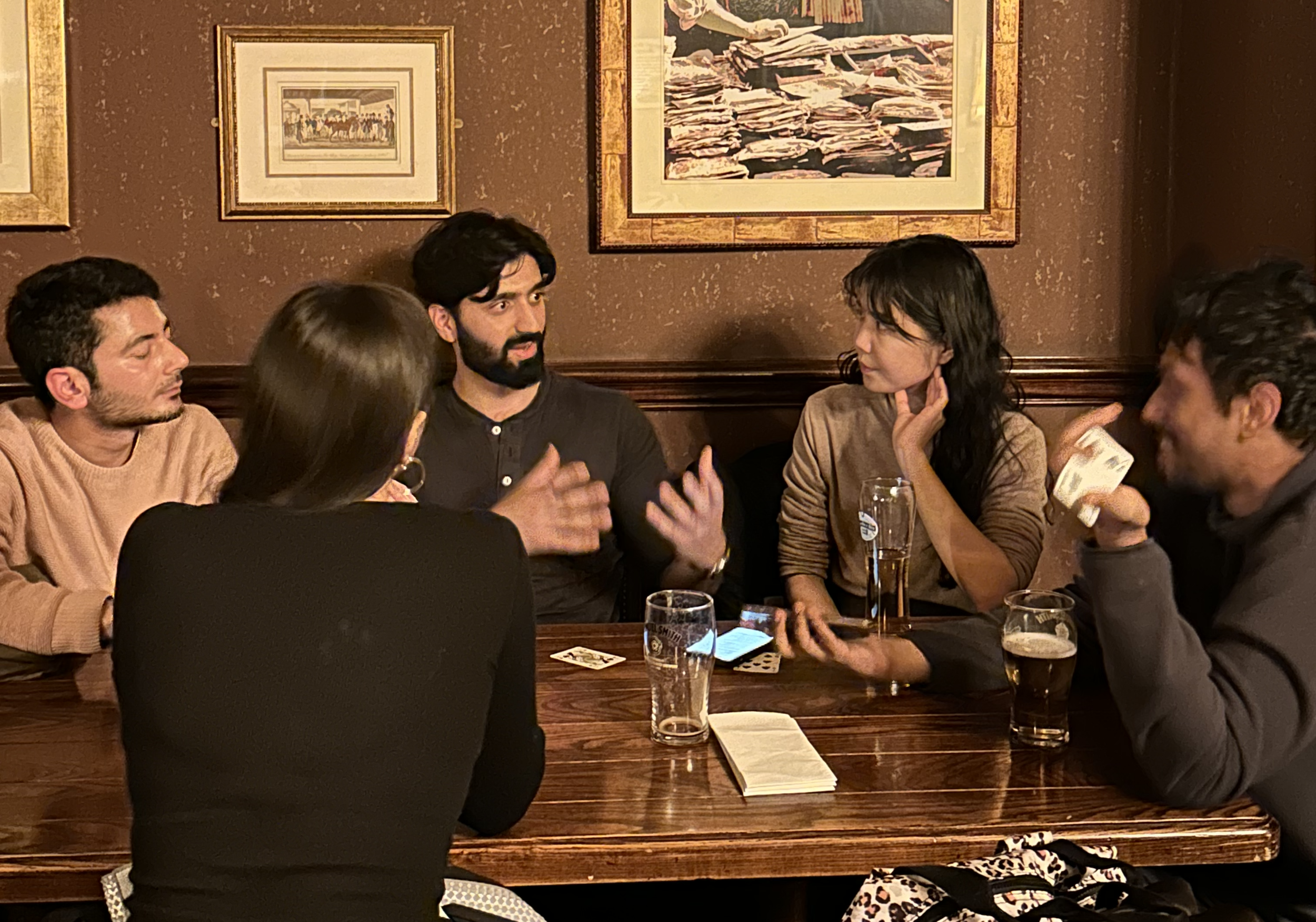
TEiP X DEBATE LONDON
“DEBATE”
by Bonny & Jess
1 CONVICTION
2 D(EB)ATING
3 RESPONSIBILITY
N.B. We will read out all three thought experiments this evening, so there is no need to read in advance.

1 CONVICTION
Bianka, Gary, and Liz are watching a high profile trial on TV:
Gary: “I couldn’t possibly argue that case. He is so obviously in the wrong. I don’t know how these defense lawyers do it.”
Liz: “Yeah, me neither, it’s so twisted.”
Bianka: “I reckon I could do it. And I actually think it's important that people do it.”
Gary: “You’d be ok with arguing in favour of awful people?”
Bianka: “You can argue something and not believe in it. It’s just about the argument.”
Gary: “But don’t you somehow compromise yourself by doing that? I don’t know, it feels like it might undermine your ethics somehow. It’s definitely not being authentic, which must impact your soul somewhat.”
Bianka: “I actually think it’s the opposite. I think by arguing an opposing point of view, you get to understand that point better and become even more clear about what you believe. You have the opportunity to then become even more true to yourself.”
Liz: “Yeah but putting your soul aside, I don’t think people like that should get defended so strongly. All the evidence is pointing towards this guy’s guilt, but it looks like he might get off because this barrister has found a technicality. That seems bad for society.”
Bianka: “Everyone deserves a fair trial and representation. There is a chance that this guy is innocent.”
Liz: “But what if he just gets off the hook because his lawyer is good at arguing. How would you feel then as the lawyer? Wouldn’t you feel at all guilty if you believed the guy was guilty, but had argued otherwise?”
QUESTIONS TO CONSIDER:
CONVICTION
Could you argue for something you don’t believe in?
What might you gain by doing so?
What might you lose?
How important is it to believe in an argument? Does it make you more convincing, or might it come with some weaknesses?
COURT OF LAW
Do you agree that everyone deserves representation at trial?
How important are ‘debating skills’ in a court of law?
How would you feel if someone you were sure was guilty was acquitted because their legal defense put up a great argument in their favour?
What if the lawyer themself admitted afterwards that they did not believe in their client’s innocence?
By Bonny Astor, founder of TEiP (THOUGHT EXPERIMENTS IN PUBLIC). Read more of her writing here.
Inspired by: Bevan Jones, H., & Frift, P. (Producers). (2013). The escape artist [TV miniseries]. Endor Productions.
2 D(EB)ATING
Misha: “I keep ending up having debates with the guys I’m dating. It is so depressing. I guess all those stats about women becoming more left wing and men becoming more right wing are right.”
Kamal: “What do you mean? I’m not right wing.”
Misha: “Yeah, but in general. I keep meeting these guys who seem all open minded at first, but then after a little while they start revealing they’re actually quite anti-migration, or anti-trans, or they vote Tory. Of course they don’t just come out with it all at once, it’s just little comments here and there. And then obviously we end up in a debate.”
Kamal: “My friend Brian who is dating at the moment was complaining that women are too woke these days.”
Misha: “Well there you go. It’s a crisis. No wonder the birth rate is declining.”
Kamal: “Do you think it is impossible for people to be in relationships and have different political views?”
Misha: “I think its hard. Politics are just the tip of the iceberg. These beliefs correspond with ideas about people’s roles in relationships, their values, their attitudes to other people, their entire worldviews! I think you’d just end up debating all the time, which might be a bit destructive.”
Kamal: “If you were arguing the whole time I’d agree, but if you were actually debating, I wonder whether it might make you both think more about your beliefs and be more intentional. I think its good for people to be aware of their opinions and to defend them. I’ll concede that maybe in a relationship it might be a bit intense to debate all the time, but what about in friendships? Should people have the same political views as their friends? Should they be open to debate?”
Misha: “Are you about to tell me that you’re voting Reform?”
QUESTIONS TO CONSIDER:
DATE NIGHT
Is it a good idea to debate on a date? What about with friends?
If you were on a date and your date brought up one of the most contentious issues of the day and asked your view on it, how would you respond?
How might debate improve a friendship/relationship? How might it harm one?
DIFFERENT WORLDVIEWS
Can people be friends and have different worldviews?
Should certain topics be avoided amongst friends/lovers? Which ones?
When (if ever) would you ‘call out’ a friend/partner/family member for their views?
How would you go about discussing differences of opinion if you wanted to preserve the relationship?
POLARISED GENDERS
Why do you think there is a general trend in young women voting more left wing and young men voting more right wing?
If this trend is true, how might it affect society?
By Bonny Astor, founder of TEiP. Read more of her writing here.
3 RESPONSIBILITY
Chi Chi, Sam and John are hanging out with their mixed ethnicity group of friends, and start talking about reparations for the slave trade.
Chi Chi: “I think Britain probably should pay reparations for slavery. But honestly, this conversation has been going on for so long that I’m tired of thinking about it.”
Sam: “I don’t think Britain should pay reparations at all.”
Chi Chi: “Why not?”
Sam: “Because the people who actually participated in the slave trade are dead. Why should people today have to pay for something they didn’t do? And, to be honest, I think black people should sort out their own problems.”
Chi Chi: “I don’t agree with that at all.”
Sam: “That’s fine. I’m allowed to have my own opinion.”
Chi Chi: “Of course you are. I just don’t understand why you’d say that in front of everyone.”
Sam: “Why shouldn’t I?”
Chi Chi: “Because people already make generalisations about black people. If one black person says something like that, people can easily take it as evidence that black people themselves don’t think reparations are necessary. I think you should be more careful about what you say in front of people who aren’t black.”
Sam: “So because I’m black, I have to think about how my opinions reflect on other black people?”
Chi Chi: “I’m saying that sometimes you have a responsibility to think about the wider consequences of what you say.”
John: “I actually think Sam’s argument is worth considering. I’m English, but I didn’t have anything to do with slavery either. My family is working class and I don’t have much money. It feels strange to say that I should have to pay for something that happened hundreds of years ago.”
Chi Chi: “But reparations wouldn’t necessarily mean that you personally are being punished.”
John: “Maybe not. But it still raises the question of who is responsible for historical injustices and how you decide who should receive compensation.”
Sam: “Exactly. And if I genuinely believe reparations are wrong, why should I keep quiet about it?”
Chi Chi: “I’m not saying you have to keep quiet. I just think that, given how often black people are treated as though one person's actions represent everyone, you should think twice before saying things that could reinforce those stereotypes.”
Sam: “But isn’t that unfair? Why should I have to censor my own opinion because other people might stereotype me?”
John: “And if Chi Chi thinks Sam has a responsibility to protect how black people are perceived, does that mean Sam has a responsibility to represent his racial group?”
Sam: “I don’t think I should have to represent anyone except myself.”
Chi Chi: “And I think sometimes none of us get to choose whether people see us as individuals or as part of a group.”
QUESTIONS TO CONSIDER:
ON WHO CAN SAY WHAT
Does where you’re from affect whether you have the right to express an opinion on an issue?
Is there a difference between having a right to an opinion and having the social permission to express it?
Are there things that are acceptable for someone from one group to say but offensive when said by someone outside that group?
If you belong to a group affected by an issue, does that give you greater authority to speak about it?
ON BEING AN INSIDER
Does being part of a group give you more freedom to criticise that group?
Why might someone be more comfortable hearing criticism of a group from a member of that group than from an outsider?
ON STEREOTYPES
If you know your words could be used to reinforce a stereotype about your group, do you have a responsibility to be more careful?
Is it fair to expect someone to modify their behaviour because other people might stereotype them?
If someone says, “I don't care how people interpret what I say,” are they being principled or irresponsible?
ON STANDARDS PEOPLE ARE HELD TO
If a white person said exactly what Sam said, would the statement be judged differently? Should it be?
Is it a double standard if Sam is expected to be more careful about his words because he is black?
Or is there a legitimate difference because Sam’s social position gives his words a different meaning?
Is it fair to hold people to different expectations based on their identity?
Can treating everyone “the same” sometimes produce an unfair outcome?
ON HERITAGE
Does being born somewhere give you a particular responsibility to defend or criticise that country?
If someone is British but their parents are Nigerian, can they speak differently about Britain and Nigeria?
Can someone be wrong to say something even when they have every right to say it?
Should people be judged on what they say, or should we also consider who is saying it and where they are coming from?
Should people today benefit from something they didn’t create or build?
By Jess Sirius, member of Debate London - LinkedIn

STAY IN THE LOOP
Join the mailing list for event updates, stories, reflections and the occasional invitation.