N.B. We have made a tiny edit to our name, from Thought Experiments in Pubs —> Thought Experiments in Public
This is to reflect the many places in which we now gather (e.g. parks, cafés, galleries, etc.), and to be more welcoming to those who prefer to avoid alcohol-focussed environments.
We still love pubs, and the informal, inclusive vibe they represent, but there are many other places with similar vibes to explore. So we’ll see you in the pub and elsewhere :-)
(You may still see “Thought Experiments in Pubs” listed here and there as we slowly update things.)
TEiP HERTFORDSHIRE
COINCIDENCE
By Sharda Dean

1 MARK TWAIN & THE BIRTHDAY PUZZLE
You’re at a networking event. The conversation is a little stilted. Rose, the organiser of the event, in an attempt to break the ice, says, ‘There are 23 people here, I bet there are at least two people who share the same birthday, let’s see how long it takes for you to find out which two.’
A few people laugh, uncertain as to whether this is a joke or not. Harry says, ‘Surely, with 365 days in a year, 23 people isn’t nearly enough for that to be likely?’
Rose smiles, ‘Just go with me on this one!’
After 5-10 mins of animated chatter as people swap their birth dates, the group finds that two people do share the same birthday.
‘What a coincidence!’ says Harry, ‘How did you know?’
Rose says, ‘It’s just basic probability. With 23 people, the chance that at least two share a birthday is about 50%. I cheated a bit of course because I have all your birth dates on your signup details, but I checked because I knew that the chances were good.’
Harry shakes his head, ’23 people definitely doesn’t seem enough to me.’
Rose says, ‘Well, you’re not alone. We tend to personalise the problem, to think of the odds of finding someone with our particular birthday, but whether any two people in the room share a birthday is a different question and is much more likely.’
A young woman called Sophia says, ‘It reminds me of the story of Mark Twain and Halley’s Comet.’
Rose says, ‘Ah, I don’t know that one.’
Sophia explains, ‘Mark Twain was born in 1835, shortly after Halley's Comet appeared. He knew the comet would return approximately 75 years later and famously said: “I came in with Halley's Comet … I expect to go out with it.” He died in April 1910, one day after the comet reached its closest point to the sun. So, the man who was born under Halley's Comet died when it returned. And he had predicted that he would.’
Harry says, ‘But Halley's Comet returns roughly every 75–76 years. So someone born around its appearance has a reasonable chance of living to see its return. Or maybe he was so keen to see it, he willed himself to stick around long enough?’
Sophia replies, ‘Who knows, but it’s a beautiful story anyway. Besides, does knowing something is reasonably likely make it less meaningful when it actually happens to you?’
QUESTIONS TO CONSIDER
What is the strangest coincidence that has ever happened to you?
Would you prefer not to understand the probability behind some coincidences and rather just enjoy them for their magical and mysterious allure?
Does knowing something is reasonably likely make it less meaningful when it happens to you?
Have you ever met someone and discovered an extraordinary number of things you had in common?
Can you find some common characteristic or other shared attribute in your group? How many can you find?
In this instance the birthday ‘coincidence’ can be explained by probabilities which can be worked out using mathematics. Is there a coincidence in your life that you still cannot satisfactorily explain?
A coincidence is defined as ‘a remarkable concurrence of events or circumstances without apparent causal connection’. In your view do either/both of the two ‘coincidences’ in the scenario described count as coincidences?
Have you ever experienced a coincidence that seemed almost impossible at the time, but which later became less mysterious when you discovered more information?
Thought Experiment by: Sharda Dean
2 ANTHONY HOPKINS AND THE GIRL FROM PETROVKA
In the early 1970s, Anthony Hopkins was preparing to appear in a film based on George Feifer's novel The Girl from Petrovka.
Hopkins wanted to read the novel but couldn't find a copy in London's bookshops.
One day, while waiting for a train at Leicester Square tube station, he noticed a book lying on a platform seat. It was The Girl from Petrovka.
He picked up the book. The book contained lots of handwritten annotations.
Later, Hopkins met the novelist George Feifer and mentioned that he had found a copy of the book. He then showed it to Feifer.
Feifer looked at it and smiled. He told Hopkins it was his own copy of the book. He said that he had owned a copy of his own novel which he had heavily annotated and had lent it to a friend who had lost it somewhere in London.
What a coincidence! Or is it?
QUESTIONS TO CONSIDER
How do you think Anthony Hopkins felt when he found the book? How might you have felt?
Human beings like to look for meaning even in random events. Why?
Do you think belief in God or other higher power might make you more likely to believe that there is meaning behind a coincidence?
We like to think of ourselves as rational beings operating with free will. But our choices are also influenced by upbringing, culture, social class, geography or circumstances. How do you think this affects the likelihood of coincidences? Which ones?
You are at a bar and order a G&T and a handsome stranger next to you also orders one? You get talking because of this and years later end up getting married. Was this just a coincidence or was the universe trying to put you together? What do you think? Why do you think that?
What’s the difference between coincidence and serendipity? Do you believe in serendipity? Why or why not?
Would the story about Anthony Hopkins and the copy of The Girl from Petrovka be more surprising if he had found the book somewhere else, eg at the top of Ben Nevis or in a pub in Potters Bar, rather than Leicester Square tube station?
Can you think of a reasonable explanation of how this coincidence might have happened?
Thought Experiment by: Sharda Dean
3 CAPTAIN KIRK & VOLODYMYR ZELENSKYY
Bev and Fred are watching reruns of the original Star Trek series. They press pause momentarily so that they can make a cup of tea.
As Fred is filling the kettle, he says, ‘Isn’t it amazing, those communicators they are using are just like mobile phones. Star Trek predicted the future!’
Bev says, ‘Not quite. Actually, the first mobile-phone pioneer said that Star Trek helped inspire his vision. Motorola later produced the StarTAC, a phone which looked just like the Star Trek communicator. Star Trek helped people imagine what communication technology could look and feel like in the future. It gave people a mental picture that a few went on to make into reality. It’s a bit like that story about President Zelenskyy… In 2015, he was an actor and comedian and began to star in the television series Servant of the People, where he played the role of the President of Ukraine. In the series his character was a high-school teacher who unexpectedly becomes president. The show ran until Zelenskyy was, actually and unexpectedly, elected as President. People had already seen him pretend to be the President, it didn’t take much for them to vote him to be the actual President.’
Fred says, ‘Yes, I heard about that. But a science-fiction programme imagining something in the 60s which eventually became real decades later? Regardless of how it happened, that’s still pretty amazing. Those inventors watching could have decided to create anything.’
Bev says, ‘Maybe, but thousands of science-fiction stories imagine thousands of technologies. Most never become real. But we don’t talk about those, we only talk about the one that resembled something that later existed.’
Fred says, ‘We only talk about those because they are the amazing ones.’
Bev says, ‘But if you throw a dice enough times, at some point you’ll throw a string of numbers that seems extraordinary. 10 sixes in a row or your own phone number. If you think of all the science fiction novels and stories and TV programmes out there, at some point one of them will get it right. How extraordinary is that really?’
QUESTIONS TO CONSIDER
Is there such a thing as coincidence or are all coincidences explicable?
According to the Star Trek and Zelenskyy examples, seeing or imagining something seems to make it more likely to happen. Do you know any other instances of this phenomenon, where something happened in fiction and then became reality? In your view how did one influence the other?
The Star Trek story suggests that the things we watch on the TV are having an influence on the direction of our lives. If that is true, what should you watch more/less of?
Has fiction (in a book, film/TV) ever inspired you to do something or change something in your life? Please share if you would like to.
Are there any coincidences that have been particularly influential or meaningful in your life in terms of influencing a big decision or general direction? Please share if you would like to.
Have you ever based a life decision on something random such as a flip of a coin? How did it work out? Would you do this, why or why not?
Have tonight’s Thought Experiments changed your view of coincidences in anyway? How?
Thought Experiment by: Sharda Dean
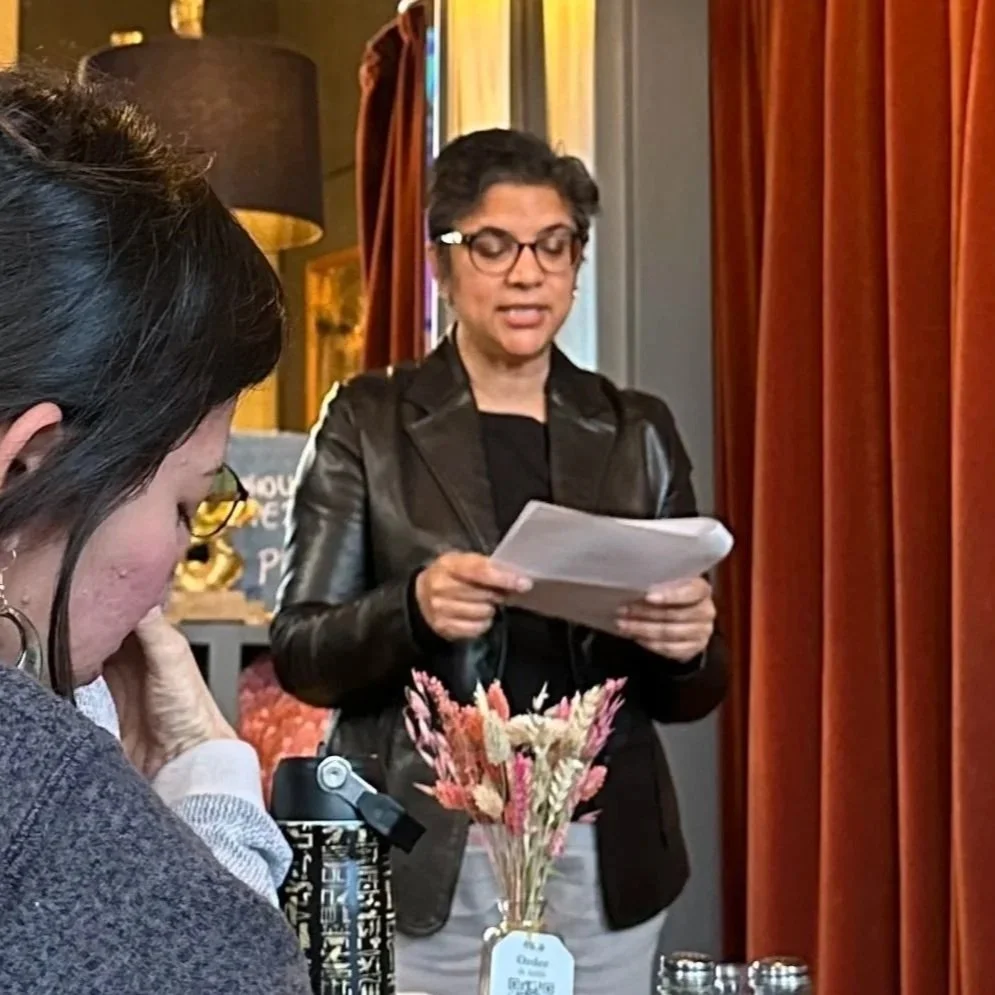
THE AUTHOR OF TONIGHT’S THOUGHT EXPERIMENTS
Sharda Dean is an economist, wedding celebrant and community builder who lives in Potters Bar in Hertfordshire.
She runs ‘Thought Experiments in Pubs (TEiP) - Hertfordshire’, part of the THOUGHT EXPERIMENTS IN PUBLIC (TEiP) network founded by Bonny Astor.
Sharda has been an active and valued member of the TEiP London community since 2025 and has contributed original thought experiments to London events.
In writing thought experiments, Sharda draws inspiration from all the love, loss, joy, heartbreak and the occasional bout of rage she has experienced in her 50+ years. She also reads widely, listens to a lot of Radio 4, has three sons and three degrees in economics.
KEEP IN TOUCH
Join the list for updates about the wider TEiP network. (Minimal comms, unsubscribe anytime).