*We have made a tiny edit to our name, from Thought Experiments in Pubs —> Thought Experiments in Public
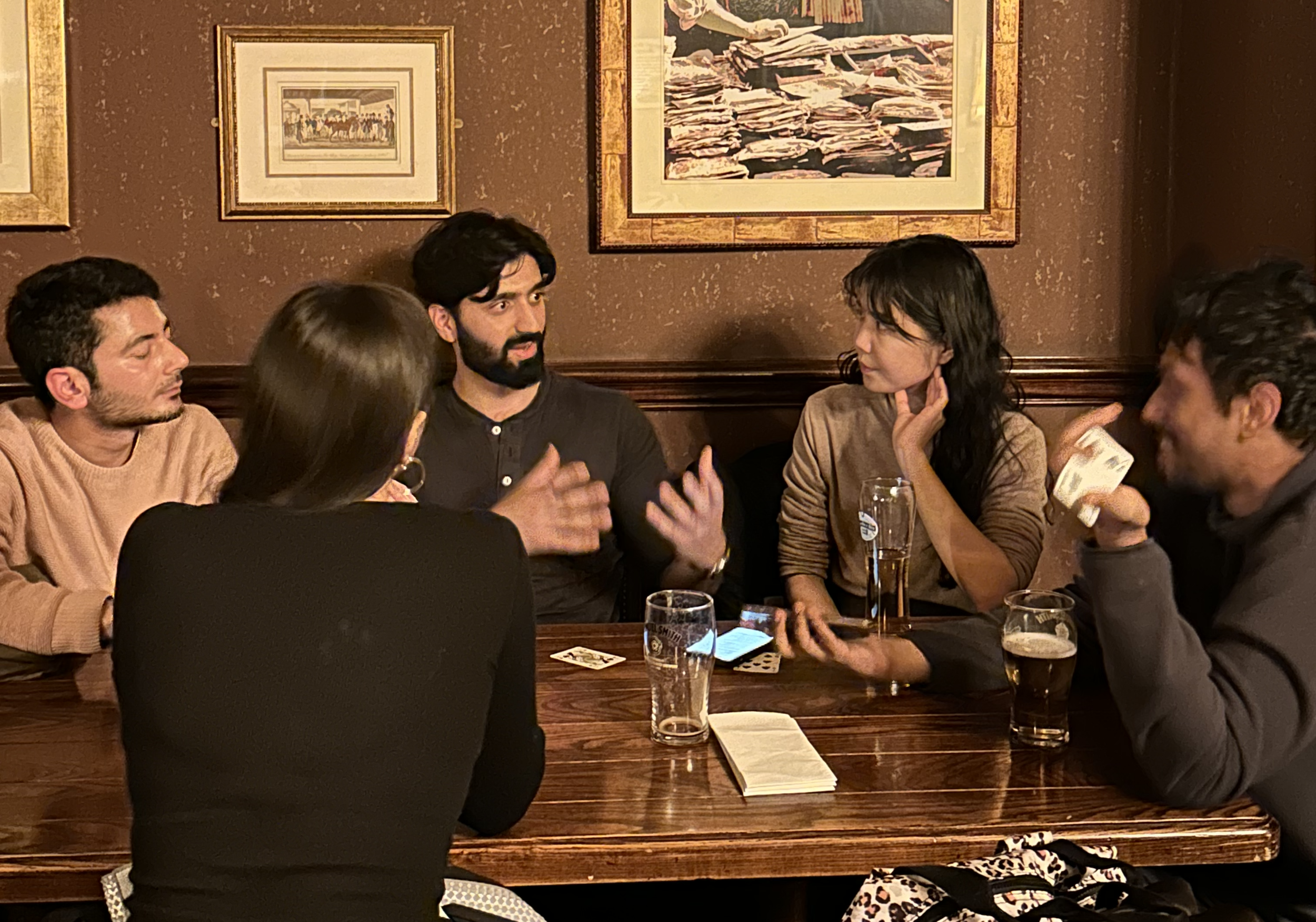
This is to reflect the many places in which we now gather (e.g. parks, cafés, galleries, etc.), and to be more welcoming to those who prefer to avoid alcohol-focussed environments.
We still love pubs, and the informal, inclusive vibe they represent, but there are many other places with similar vibes to explore. So we’ll see you in the pub and elsewhere :-)
(You may still see “Thought Experiments in Pubs” listed here and there as we slowly update things.)
S3E5
AGENCY
by Lennon
INTRO: THE MACHINE
1 AGENCY
2 IDENTITY
3 AUTHORSHIP
N.B. We will read out all three thought experiments this evening, so there is no need to read in advance.

INTRO: THE MACHINE
One evening, while walking home, you notice a light inside an abandoned factory. You’ve walked past this building many times before, but tonight is different. Not just because of the light, but because the door is standing wide open.
Curiosity draws you inside, and in the empty factory you see a single machine, about the size of an arcade machine.
The screen is lit up, and the words “press start” flash across it. On the panel below, is a small imprint for your finger, and the word “start” above it.
Instinctively you press the button, and instantly you feel a small pin prick. Glancing at your finger you see a small bead of blood.
The text on the screen changes to 3 options.
Review.
Diverge.
Change.
1 AGENCY
You press the first option, and a timeline of your life appears. It stretches across the screen, filled with hundreds of thumbnail previews.
Ten are larger than the others, each playing a short clip.
As you scan them, you begin to recognise the moments.
A childhood friend you don’t talk to anymore.
A party you’d almost forgotten.
A job you once had.
One or two take a moment to place. Others are immediately familiar.
The earliest shows you at seven years old.
The last shows you walking into the factory tonight.
Also on the screen, a short paragraph of text appears.
The instructions read as follows.
“Every decision you make can change the course of your life. These are the 10 turning points that most influenced you. These are the moments that put you on the path you’re on right now.
Review: yes or no.”
QUESTIONS TO CONSIDER
Would you press YES, press NO, or simply walk away? Why?
What factors would strengthen or weaken your decision?
Would what you’ve learned from The Machine change the way you live afterwards?
Would you ever introduce another person to the machine? Why or why not?
What responsibility, if any, comes with knowing the machine exists?
By Lennon, TEiP Community Member
2 IDENTITY
Back in the main screen you now choose the second option.
Diverge.
The screen changes to a new set of instructions:
“A perfect biological and neurological duplicate of yourself will be created, containing all your current memories and experiences up to the point of creation.
For one year, both of you exist independently, but only one of you can continue afterwards. Together you must decide who.
You now have a choice, to live your current life, and let the clone find its own path, or let the clone live your current life and you choose your own.”
An image of you appears on the screen.
It’s wearing your clothes, and even has the tuft of hair displaced by the wind outside that, until now, you hadn’t noticed. There’s also the faint red smudge on your chin where you absent mindedly rubbed you face.
Even though it’s only an image on a screen, something about it looks more real than a photograph.
And you’re looking directly into the camera.
You glance over The Machine, but can’t see where a camera could be hidden.
Beneath the image, your timeline from before is still visible. At its final point, another line now branches away. Both begin at tonight.
Then on the bottom of the screen.
“Create clone: yes or no.”
QUESTIONS TO CONSIDER
1. Would you create the clone at all? Why?
2. Which life would you choose for yourself: the one you’re already living, or the unexplored path?
3. At the moment you separate, is either version more entitled to the life you’ve lived up until tonight?
4. After a year of different experiences, how much of the person standing there would still be shared between you?
5. If only one life can continue, what should determine which one it is?
By Lennon, TEiP Community Member
3 AUTHORSHIP
On the main screen again, you now select the third and final option.
Change.
Your timeline appears again, with more details than before. It shows you the outline of every branch your life could take. Each line breaks off again and again.
Some are longer than your current timeline, others are shorter.
One is much shorter than the line your currently on.
But you notice something else.
The timeline doesn’t stop at today.
More large thumbnails appear, showing moments you don’t recognise.
People you’ve never met.
Places you’ve never visited.
And an elderly version of you.
The new instructions scroll across the screen as follows.
“Each branch represents an alternate path of your life. The highlighted turning points represent the majority divergences from your current timeline.
You may choose one point in the past or future, and change the path you’re currently on.
You can see the shape of each branch, but none of its contents.
Change timeline: yes or no.”
QUESTIONS TO CONSIDER
1. Would you change one of the highlighted turning points at all? Why?
2. Would knowing the shape of the branches make you more or less willing to change your path?
3. If you chose not to change anything, would that now make you responsible for the path you’re already on?
4. If some branches were longer and others shorter, but you knew nothing about the lives within them, how much should lifespan influence your choice?
5. Would you rather change something behind you, or choose something ahead of you? Why?
By Lennon, TEiP Community Member
THE AUTHOR OF TONIGHT’S THOUGHT EXPERIMENTS
Lennon comes from a background in transport and logistics, which has shaped his systems-oriented thinking. To counteract this, he spends much of his time inhabiting a realm of the abstract and the absurd. Two opposing forces, perhaps, but ones that seem to coexist quite comfortably in his mind.
An intrepid nomad, Lennon has lived across a couple of continents, a few countries and several cities. His travels have shaped how he sees the world, exposing him to different perspectives and ways of thinking.
When writing thought experiments, Lennon has only one aim: to find another way of looking at a problem. He builds his stories in a sandbox, introduces a few complications, and accepts that things might get a little messy. He's interested less in prescribing answers than in discovering what happens when the answers we take for granted are put to the test.
You can stay in touch with Lennon on instagram: @lennon_lives

STAY IN THE LOOP
Join the mailing list for event updates, stories, reflections and the occasional invitation.